Thursday, January 3, 2008

St. Mary, Edgerton: The Plot Thickens

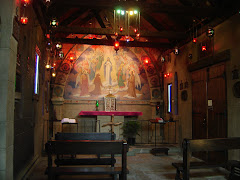
This is one of the ceiling murals in the aisles of the cathedral. It was painted by John ( Jan Henryk ) de Rosen, one of the most highly respected Catholic artists of the 20th century. De Rosen was born at Warsaw, in 1891 and died at Arlington, Virginia, in 1982. In the course of his life, he left behind a massive number of murals, mosaics, and paintings, in churches from Lvov to San Francisco. Pius XI commissioned two murals for his private chapel at Castel Gandolfo. The great cathedral at St. Louis has many examples of his mosaic work. Possibly his best known work is the enormous Christ in Majesty mosaic, in the apse of the National Shrine of the Immaculate Conception, in Washington. HERE'S a brief biographical sketch.
Toledo is fortunate enough in having just the murals he did for the cathedral, but there's more to the story.
In 1945, John de Rosen painted an altarpiece and two murals for St. Mary's in Edgerton. I still haven't seen clear pictures from St. Mary's, but everything I have seen makes me suspect my source may have been right in calling it the most beautiful parish church, not just in the diocese, but in Ohio.
These pictures were scanned from an article in the Chronicle. I'll post more of the story tomorrow.

The Purloined Letter Award

....for a treasure hidden in plain sight, goes to Good Shepherd, in East Toledo. Everyone notices it, but not nearly enough look closely enough to find out that it's one of the most beautiful churches in the diocese.


Welcome Back...

....and a belated happy birthday, to Alex Fries, who's been roaming around in Bavaria.

A Mystery Solved

I've been puzzled, for the past few months, by Holy Angels, in Sandusky. It's considered the oldest extant church in the diocese, having been built in 1843. Here's a very early picture of it. It's not easy to grasp just how much of an accomplishment it was, at the time, to build anything this impressive, when all the other churches in the area were very simple frame or brick structures. Holy Angels went further, by building in stone and adding the extra Gothic detailing that was still rather rare. The first church in the United States to show Gothic influence was built, I believe, in 1807. The style was slow in spreading toward the frontiers, and the "Carpenter Gothic" was just beginning to attract notice, so this must have been quite a sight when compared to the simple Greek Revival and Georgian churches the area was used to.
Here's what it looked like in c1900. Once again, we have a lost spire. One very unusual feature is the presence of those two round windows, and particularly the way they're arranged. A single rose window, in the middle, was common, but two, side by side, is rather odd. The transom over the entrance looks like it might have been stained glass. Very interesting building.
Now, as I've said, Holy Angels is considered the oldest parish church in the diocese, but there's a problem.
This is what it looks like today. Very nice building, but not the same. Everyone I asked agreed that the original church is somewhere in there, but no one could tell me when and how the change was made, until now.
A few days ago, Kevin Hammer drew my attention to an excellent blog called Sandusky History, written by the staff of the Sandusky Library Archives Research Center. I left a comment asking for information and they responded quickly.
Fr. Thomas P. Lamb, pastor from 1893 to 1903, carried out an expansion project which was finished by 1902. An 35-foot addition was built in front of the church. The original tower was removed and replaced with one at the side. The 1843 church is still there, but looks completely different from the front. Holy Angels is the oldest extant parish church in the diocese, with the caveat that St. Patrick's in Providence, built I believe in 1848, is the oldest to survive in its original condition. That nakes two to be recognized.

Wednesday, January 2, 2008


New Blog

Be sure to visit The German Egyptian, a blog devoted to the churches of Mercer County. There are some real gems.

Beautiful Churches

Dwight Longenecker has a good post on the reason why churches should be filled with beauty.

Immaculate Conception, Old South End


St. John, Payne

Very nice. Still there?

The Taking out the Garbage Award

....for the ugliest building ever used as a church in the Diocese of Toledo, goes to old St. Patrick's, in Bryan. This c1960 monstrosity took the word "awful" to new heights.
In fairness, it was meant to be a school gymnasium ( And looks it. ) and was a stopgap measure until a new church could be built. The parishioners suffered this little corner of Purgatory for much longer than expected. When the new church was finally built, they made it a gem.

The Wave of the Future Award

....for the best example of the new eclecticism goes to St. Michael's in Findlay. Romanesque form, post-modern style. Excellent work.

The le Corbusier Memorial Award

....for best church exterior, in a contemporary style, goes to All Saints, in Rossford. No one could mistake this for a dentist's office. That entrance arch and the gable, that seems to rise forever, are the best of late 20th century architecture, even if it was built in the 21st century.

Tuesday, January 1, 2008

Immaculate Conception, Old South End


The Raising the Dead Award...

..... with a laurel wreath for reversing a wreckovation, goes to All Saints in New Riegel, for restoring the murals when they could easily have been forgiven for giving them up as a lost cause.
See what I mean?

The English Country House Award...

....for the best example of an artwork added to an older church of a completely different style without sticking out like a sore thumb, goes to Immaculate Conception, in the Old South End, for the Pewabic pottery War Memorial. The modernistic style of the Pieta matches the coloration of the rest of the church, and the general high quality of the artwork, so well that it fits right in.

The Rad-Trad Baiting Award...

...for the best modern church interior in the diocese, goes to St. Peter's in Huron. Soaring would be the word. It has the same noble effect as the great baroque domes, put in modern form. It also uses quality materials and subdued colors, to avoid the "mothership" feel of too many of its kind. That chandelier is fantastic. The windows are good. Even looks like the tabernacle is in the right place. I think what appeals to me most is the play of light and shadow, which gives a tone of the sacred that's all too rare in contemporary architecture. Most churches of the 60's and 70's look as old-fashioned as bell-bottoms and lava lamps. This just looks magnificent. GOOD JOB!
One other note. The resurrifix is actually, wonder of wonders, well made. As long as there's a real crucifix in the mix, even I wouldn't have a problem with it.

A Bit of a Surprise

I learned, yesterday, that one of the dignitaries present at the laying of the cornerstone of the cathedral, on June 27, 1926, was Janos, Cardinal Csernoch, Archbishop of Esztergom and Primate of Hungary. Ten years earlier, the Cardinal crowned Bl. Karl of Austria as King of Hungary.

A Breath of Fresh Air


Christmas Oratorio

Monday, December 31, 2007

Precious Mitres and Baroque Vestments


There's a very strong, but right on target, post on the breath of fresh air at the Vatican, at Shouts in the Piazza. I'd recommend reading it.